Nursing careers guide covering the shortage, top-paying specialties, AI, telehealth nursing, and ADN versus BSN decisions in 2026.
Career Guide | Updated April 2026
Nursing Careers in 2026: The Ultimate Guide to Specialties, Salaries, and Tech

Welcome to the front lines of modern healthcare. An aging population, a historic staffing crisis, and rapid AI adoption are reshaping what a nursing career can look like in 2026.
Quick Take
- Shortage advantage: qualified nurses still hold unusual leverage in hiring, scheduling, and tuition support.
- Best pay upside: anesthesia, psychiatric care, family practice, and informatics remain the strongest specialty bets.
- Future-proof move: combine bedside credibility with tech fluency, licensure mobility, or employer-funded education.
Bedside nursing is no longer the only path. Today, advanced practice nurses can command salaries above $200,000, while hospitals increasingly use technology to reduce documentation drag and support better patient outcomes.
Whether you are a prospective student mapping out your education, an RN exploring non-clinical nursing careers, or a clinician trying to understand how AI changes workflow, this guide is built to help you plan from a stronger position.
Below, we break down the shortage, the top-paying specialties, the telehealth shift, and the degree decisions that shape return on investment in 2026.
Table of contents
The 2026 Nursing Shortage: Why Job Growth Favors You
The phrase nursing shortage 2026 still defines the healthcare sector this year. While the shortage creates real pressure for hospitals and health systems, it also gives qualified nurses stronger job security, wider mobility, and unusual leverage when comparing employers.
The Numbers Driving the Crisis
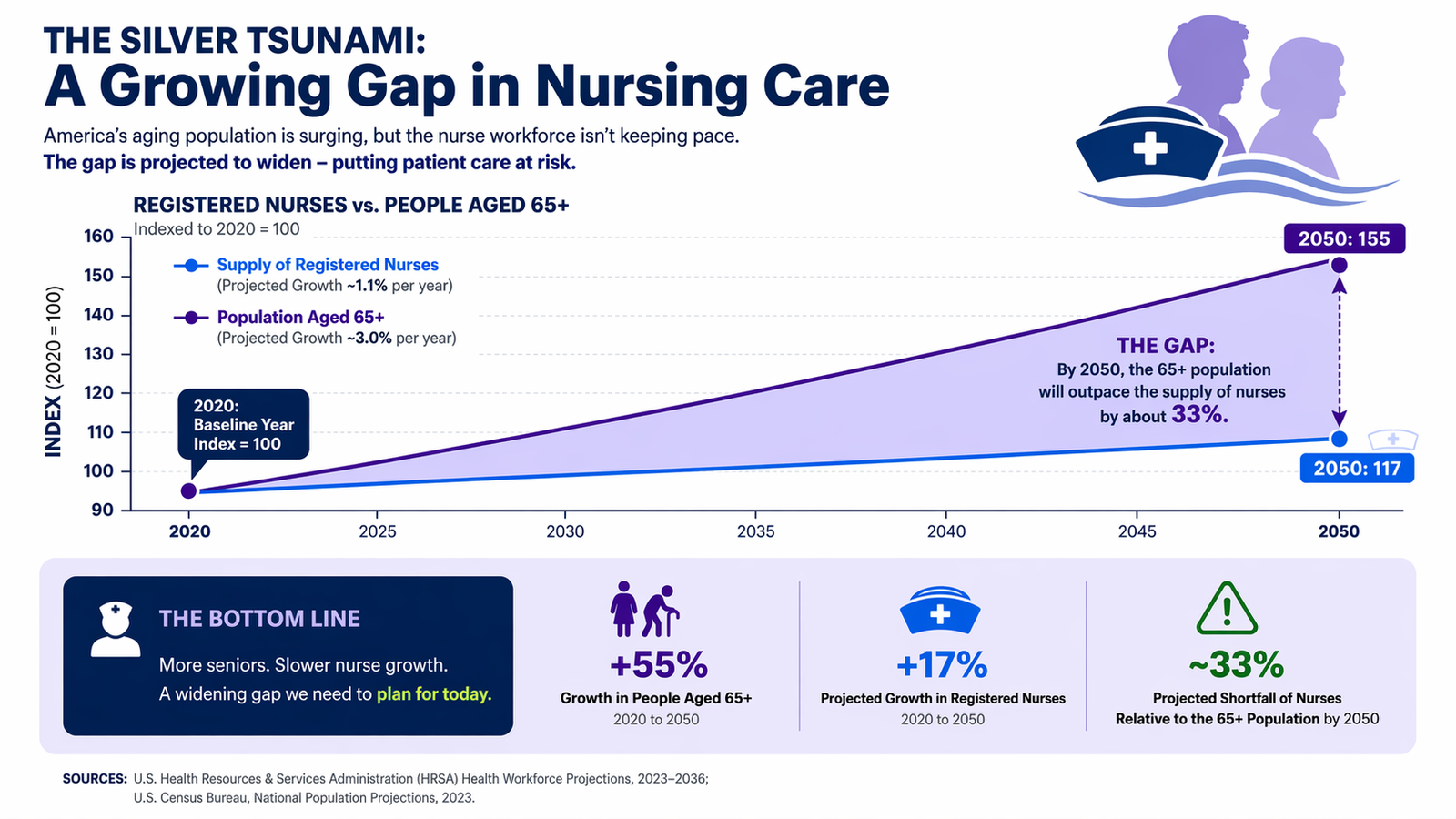
Healthcare demand continues to outpace the supply of trained professionals. Based on workforce projections cited in the source document, the United States faces a deficit of roughly 358,000 vacant nursing positions by the end of 2026.
Three colliding factors drive this gap:
- The "Silver Tsunami": by 2030, every Baby Boomer will be at least 65, raising demand for more frequent and complex care.
- Mass retirements: the RN workforce continues to age, with roughly 1 million nurses expected to leave the field by decade's end.
- The educational bottleneck: too few nursing educators and clinical placements force schools to turn away qualified applicants each year.
How the Shortage Boosts Your Career Leverage
For nurses, this supply-and-demand imbalance creates a real candidate's market. Registered nurse openings remain steady, but advanced practice roles are where the growth curve becomes especially aggressive, with the APRN workforce tracking roughly 35% to 40% growth in the source material.
Hospitals and large systems now compete with signing bonuses, flexible scheduling, stronger tuition reimbursement, and more willingness to hire into specialty pipelines. In plain terms, 2026 remains one of the strongest years in recent memory to hold a nursing license.
Top 5 Highest-Paying Nursing Jobs in 2026
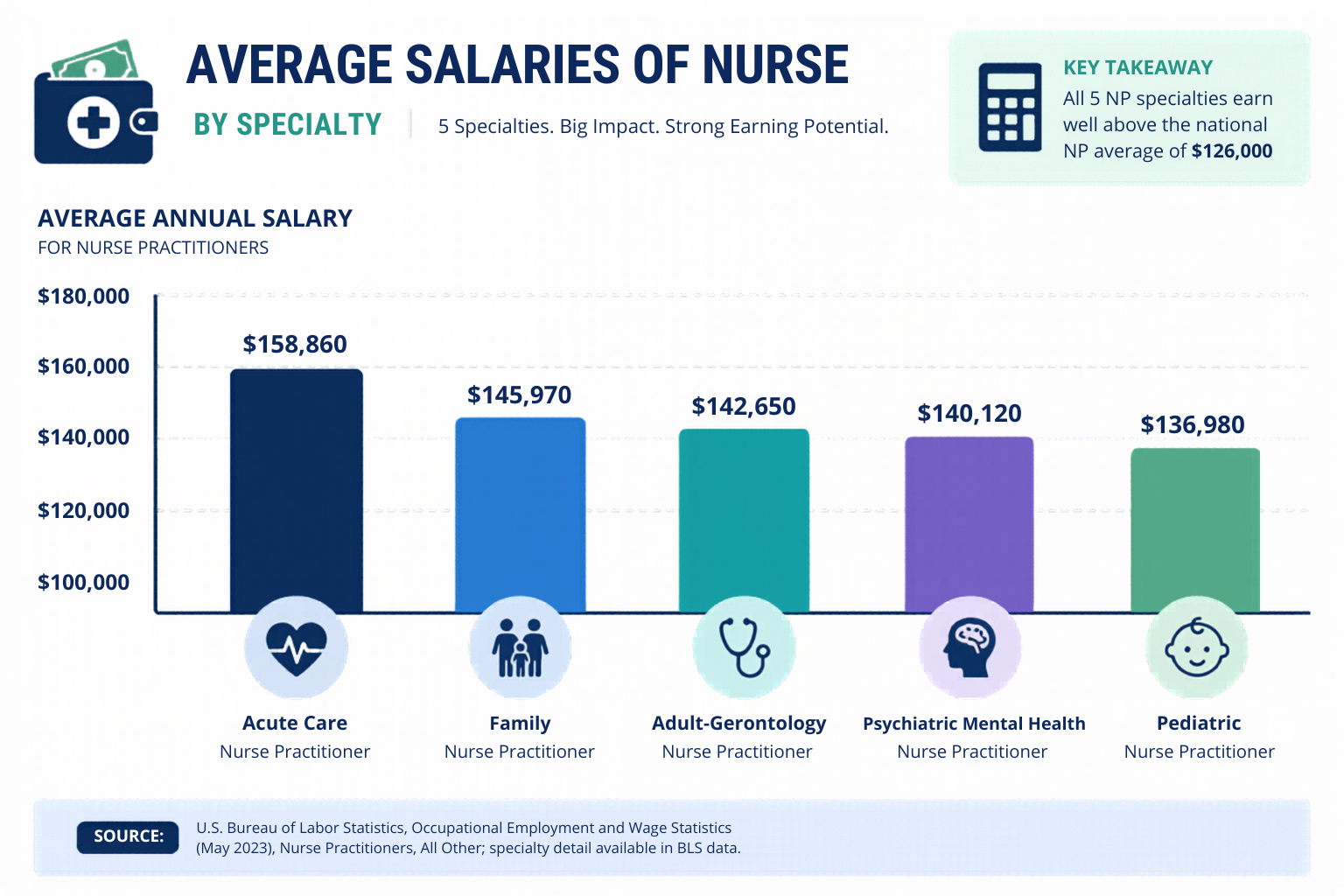
A staff RN salary can provide a strong living, but the real income ceiling comes from specialization. The highest paying nursing jobs in 2026 generally require advanced education, deeper clinical responsibility, or a role that connects clinical judgment with a hard-to-staff care model.
1. Certified Registered Nurse Anesthetist (CRNA)
Average 2026 salary: $210,000 - $234,000+
The role: CRNAs remain the top earners in nursing, administering anesthesia and managing pain across surgical, obstetrical, and trauma procedures.
The path: You need an active RN license, ICU or critical care experience, a DNP under current entry mandates, national certification, and state licensure.
2. Psychiatric Mental Health Nurse Practitioner (PMHNP)
Average 2026 salary: $128,000 - $150,000+
The role: PMHNPs assess, diagnose, prescribe, and often deliver psychotherapy. Telehealth has made private and hybrid psychiatric practice especially attractive.
The path: This route requires an MSN or DNP focused on psychiatric-mental health plus board certification.
3. Family Nurse Practitioner (FNP)
Average 2026 salary: $125,000 - $140,000
The role: FNPs fill critical primary care gaps by diagnosing illness, managing chronic disease, and prescribing treatment. In full-practice states, they can run clinics with substantial independence.
The path: Expect to complete an MSN or DNP and earn national certification before entering independent or semi-independent practice.
4. Certified Nurse Midwife (CNM)
Average 2026 salary: $120,000 - $136,000
The role: CNMs specialize in pregnancy, childbirth, postpartum care, and reproductive health. Demand keeps rising as more mothers seek holistic, relationship-based care models.
The path: You need an RN license and graduation from an accredited MSN or DNP nurse-midwifery program.
5. Nursing Informatics Specialist
Average 2026 salary: $98,000 - $115,000
The role: Informatics nurses sit between patient care and IT, managing EHR workflows, staff training, analytics, and software rollouts that affect clinical quality.
The path: A BSN plus clinical experience is the usual base, often followed by an informatics-focused MSN or targeted certifications through groups such as HIMSS.
AI in Nursing: Will Algorithms Replace RNs?
The short answer remains no. AI cannot replace empathy, bedside observation, or hands-on patient assessment. What it does change is the amount of time nurses spend documenting, monitoring, and coordinating routine workflow.
Reclaiming Time from the Computer
Manual charting has historically consumed a major share of every shift. In 2026, ambient clinical voice tools now transcribe assessments and structure them directly into the EHR, cutting hours of repetitive typing from the week for nurses who work in systems that deploy them well.
Predictive Analytics and Proactive Care
AI-powered monitoring also helps teams spot risk earlier. By tracking subtle changes in vital-sign patterns and wearable-device streams, algorithms can flag deterioration and complications such as sepsis before bedside symptoms become obvious.
The Rise of the Nurse Innovator
Hospitals need clinicians who understand both care delivery and system design. Nurses who can translate bedside workflow into better software decisions are increasingly valuable in informatics, implementation, and operational leadership roles.
The Remote Nursing Boom: Landing Telehealth Nurse Jobs
For nurses burned out by the physical demands of bedside work, the telemedicine boom has turned remote nursing from a niche path into a mainstream option. Telehealth nurse jobs now span virtual hospitals, triage programs, chronic-care follow-up, and remote patient monitoring teams.
The Virtual Nursing Model
Many hospitals now use hybrid care teams. A bedside nurse handles hands-on tasks while a virtual nurse joins by secure screen to take over time-heavy coordination work such as:
- Exhaustive admission histories
- Complex discharge education
- Care coordination and pharmacy referrals
- Second-opinion chart reviews
That split reduces pressure on floor nurses and creates legitimate work-from-home nursing pathways that still rely on clinical judgment.
Remote Patient Monitoring (RPM)
Telehealth nurses increasingly manage chronic-condition patients through smart home devices and continuous monitoring. They intervene earlier, escalate sooner, and help prevent avoidable emergency visits. The Enhanced Nursing Licensure Compact further strengthens this model by letting one multistate license support care across participating states.
ADN vs. BSN: Maximizing Your Degree ROI in 2026
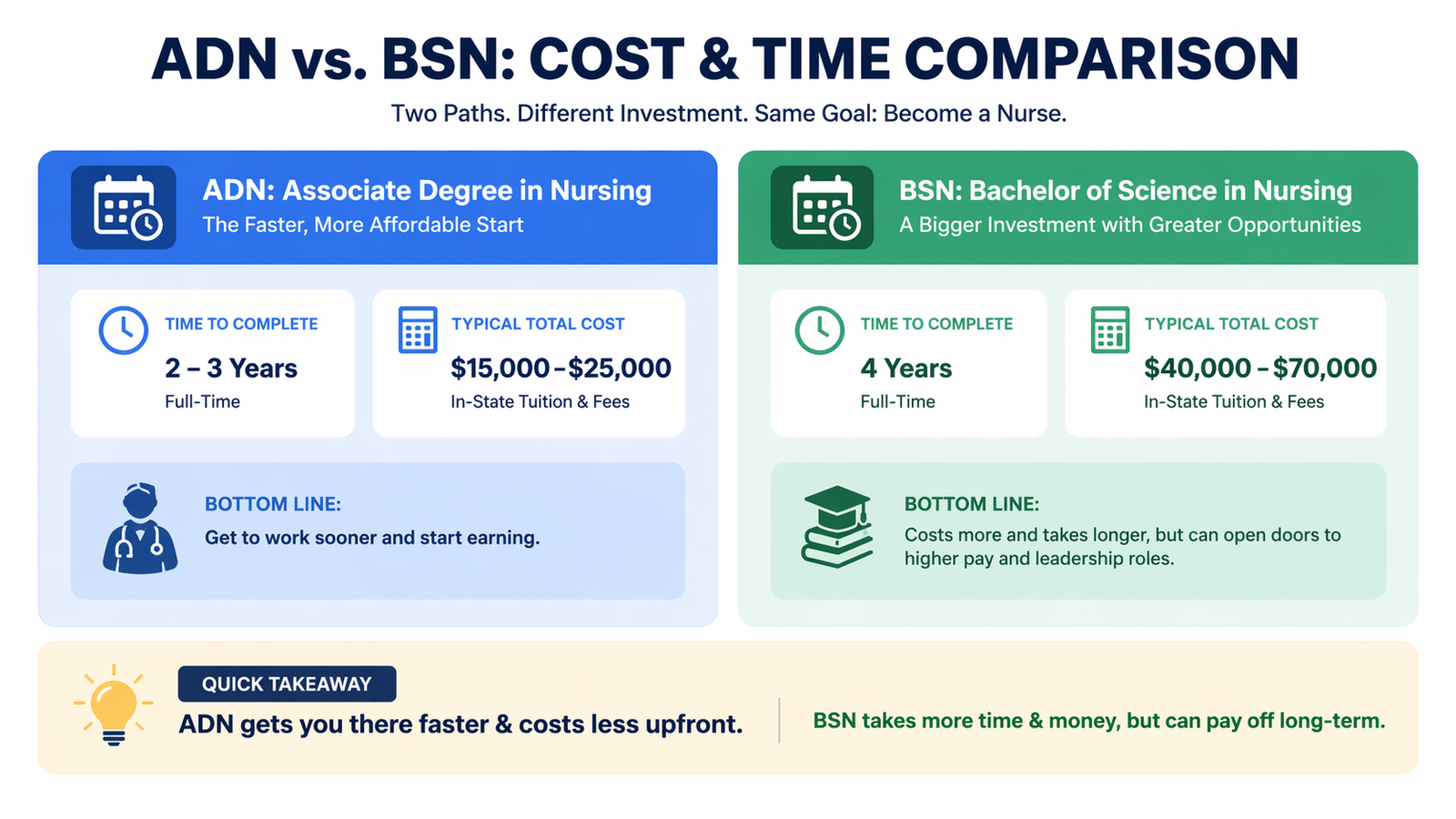
For entry-level nurses, the ADN versus BSN decision is still one of the most practical financial questions in the profession. The best route depends less on prestige and more on how quickly you need income, how much debt you can tolerate, and which employers you want access to early.
The ADN: Speed and Cost-Efficiency
An ADN remains the fastest, most affordable route into RN practice. Community-college programs typically lower tuition pressure while still qualifying graduates for the NCLEX-RN and early bedside employment.
The BSN: The Hospital Standard
Many Magnet and academic hospital systems prefer BSN-prepared hires, while others will hire ADN nurses only if they agree to finish the BSN within a few years. That policy reflects employer pressure around quality metrics, leadership development, and future staffing mix.
Future-Proofing Your Healthcare Career
The year 2026 marks a defining moment for nursing. The profession still faces real strain, but nurses now have wider career flexibility, stronger specialty pay, and better technology support than they did only a few years ago.
The safest long-term strategy is to treat your license as a platform rather than a fixed role. Build bedside credibility, then layer on one or more of the growth levers this guide keeps pointing to: specialty training, licensure portability, employer-funded education, or digital workflow expertise.
- 1Start where demand is strongest. Shortage-heavy settings still offer the fastest route to experience, leverage, and employer support.
- 2Pick a specialization intentionally. Advanced practice, psychiatric care, anesthesia, and informatics all change the earnings ceiling.
- 3Use technology to your advantage. Learn the digital tools changing documentation, monitoring, and virtual care instead of resisting them.
- 4Protect ROI on education. Match your degree path to your cash-flow timeline and use tuition reimbursement whenever possible.
Ready to compare more healthcare paths?
Use the jobs blog to explore nursing, travel nursing, NP, allied health, and other fast-growing clinical career guides in one place.
Explore Nursing GuidesSources referenced in the source guide include Health Resources and Services Administration workforce projections, U.S. Bureau of Labor Statistics outlook and wage data, nursing informatics guidance, telehealth market reporting, and nursing licensure compact materials.