Career Guide | Reviewed April 18, 2026
Medical Assistant Career Guide 2026

Your 2026 guide to pay, certifications, daily responsibilities, and the clinic-side skills that help medical assistants get hired and move up.
Quick Take
- Best for: people who want a fast entry into healthcare and a real view of how clinics run.
- Business value: strong MAs improve patient flow, documentation quality, referrals, and follow-up.
- Advancement path: CMA or RMA plus specialty and operations skills can open lead medical assistant, office manager, or practice administrator tracks.
Table of contents
- What is a medical assistant and why is the role growing?
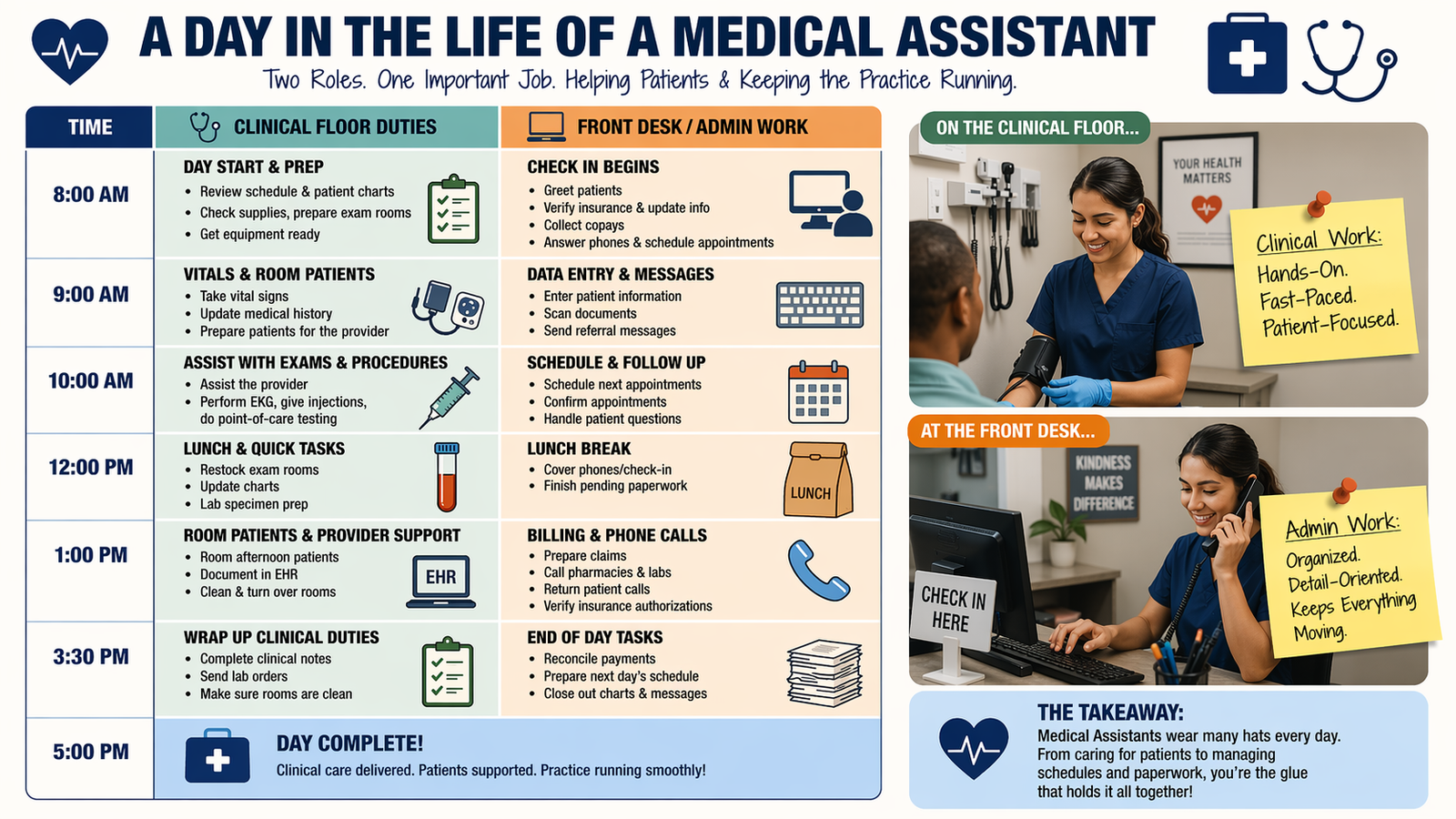
- Core duties: clinical vs. administrative
- Salary by setting, certification, and experience
- Top certifications employers recognize
- Step-by-step path to becoming a medical assistant
- Career crossroads: medical assistant vs. CNA vs. LPN
- Career advancement and highest-paying specialties
- In-demand skills employers look for in 2026
- Frequently asked questions
Scope note: This guide focuses on the U.S. medical assistant career track because that title has the clearest published salary, certification, and job-outlook data. If you are searching from India, use this page to map transferable skills, but expect similar work to appear under related titles such as clinic assistant, patient care coordinator, phlebotomy assistant, OPD support, or front-office healthcare roles depending on the employer.
If you want a healthcare job that teaches both patient care and how outpatient clinics actually operate, medical assisting is one of the clearest entry points.
Medical assistants room patients, take vitals, update charts, support procedures, manage messages, and keep schedules moving. In a busy practice, that work affects provider productivity, patient experience, and how smoothly visits turn into completed care and clean documentation.
This guide explains the role in plain language. You will learn what medical assistants do, what the pay data actually shows, which certifications matter most, and how the job can grow into specialty or practice-operations leadership.
What is a medical assistant and why is the role growing?
A medical assistant (MA) supports patients, clinicians, and office staff in outpatient care. Most MAs work in physician offices, urgent care centers, specialty practices, and other clinic settings.
The role matters because one person can help from check-in to checkout. A medical assistant may take a patient's vitals, prepare the exam room, update the record, answer a follow-up call, complete a referral step, and help close the visit without breaking clinic flow.
The U.S. Bureau of Labor Statistics projects 12 percent job growth from 2024 to 2034 for medical assistants, with 112,300 openings a year on average. BLS also reports that 57 percent of medical assistants work in physician offices and 10 percent in outpatient care centers, which shows how concentrated the role is in ambulatory care.
Why clinics treat strong medical assistants as business-critical staff
In most ambulatory practices, medical assistants are part clinical support and part operations engine. They help protect room turnover, schedule capacity, chart readiness, referral completion, and the patient communication that keeps follow-up visits from slipping away.
That operational importance lines up with broader care-delivery trends. The AHA's 2026 Environmental Scan says outpatient volume is forecast to grow 18 percent by 2035, office or clinic in-person care 13 percent, and hospital outpatient or ambulatory surgery center activity 14 percent. As clinics absorb more volume, they need cross-trained staff who can support both care and throughput.
The Rise of Remote Medical Assistant Roles
Remote medical assistant jobs are still a smaller slice of the market than in-person clinic roles, but virtual-care workflows are expanding. The same AHA scan says 19 percent of evaluation and management visits may occur virtually by 2035. That is not a direct forecast for remote MA employment, but it is a useful signal that clinics will need more staff who can support digital intake, portal messaging, refill routing, and follow-up coordination.
In practice, remote or hybrid medical assistants often handle telehealth pre-visit intake, chart preparation, prior authorizations, referral follow-up, inbox work, patient reminders, and care-gap outreach. The strongest candidates combine EHR fluency, privacy discipline, and clear written communication.
Core duties: clinical vs. administrative
Medical assistants move between the exam room and the front desk. Employers value that flexibility because it keeps clinics efficient during busy shifts.
Clinical duties
- Recording vital signs (blood pressure, pulse, temperature, respiration rate)
- Performing phlebotomy and preparing lab specimens
- Administering medications and vaccinations (where state law permits)
- Assisting physicians during examinations and minor surgical procedures
- Performing EKGs and spirometry testing
- Sterilizing instruments and maintaining examination rooms
Administrative duties
- Managing electronic health records (EHR) such as Epic, Cerner, and Athenahealth
- Scheduling appointments and managing patient flow
- Handling billing, coding (ICD-10, CPT), and insurance verification
- Obtaining referrals and prior authorizations
- Communicating with patients about test results and follow-up instructions
How medical assistants affect clinic performance
- Cleaner claims: accurate demographics, insurance details, and documentation reduce avoidable billing problems.
- Better patient flow: room prep, chart prep, and fast handoffs help providers stay on schedule.
- Less referral leakage: prior authorizations, referral tracking, and callback follow-through keep patients from dropping out of the care path.
- Provider efficiency: when the room, chart, and orders are ready, clinicians can spend more time on decisions and less on recovery work.
- Patient retention: reminders, portal follow-up, and consistent communication improve the experience patients remember.
Salary by setting, certification, and experience
According to the U.S. Bureau of Labor Statistics, medical assistants earned a median annual pay of $44,200 in May 2024. The public BLS data is strongest at the occupation and industry level, so that is the cleanest benchmark to use when comparing settings or evaluating job ads.
Use the figures below as U.S. benchmark data for the standardized medical assistant title. On India-focused job boards, similar responsibilities are often distributed across different job titles, so pay should be checked on each live posting rather than assumed from U.S. salary data.
What the 2024 BLS pay data shows
Employer settings that often pay more
| Employer setting | Common pay pattern | Why it stands out |
|---|---|---|
| Outpatient care centers | $47,560 median | Fast pace, broader procedure mix, and strong patient volume |
| Hospitals and health systems | $45,930 median | Larger teams, more complex workflow, and possible schedule differentials |
| Physician offices | $43,880 median | The most common entry setting with consistent hiring |
| Offices of other health practitioners | $37,510 median | Can be lower paying, depending on scope and visit complexity |
Top certifications employers recognize
Certification is not always required by law, but many employers prefer it. It can help you stand out, especially when you apply to specialty clinics, larger systems, or roles with more clinical responsibility.
Add-on certifications worth considering
Step-by-step path to becoming a medical assistant
The path is shorter than many healthcare tracks. For most people, the goal is to train quickly, get real clinical exposure, and enter the job market with a clean resume and a recognized certification.
-
1
Finish high school or earn a GED. This is the base requirement for most training programs and employers.
-
2
Choose an accredited program. Look for CAAHEP or ABHES accreditation if you want the strongest path toward the CMA exam.
-
3
Complete clinical training. Externships give you hands-on practice with rooming patients, taking vitals, charting, and clinic workflow.
-
4
Take your certification exam. Test soon after training while the material is fresh and your study habits are still active.
-
5
Apply to the right settings. Prioritize clinics, urgent care centers, specialty offices, and hospital outpatient departments that match your skills and schedule goals.
-
6
Keep building your value. Add CEUs, EHR experience, and specialty skills so you can move into stronger roles over time.
Career Crossroads: Medical Assistant vs. CNA vs. LPN
These roles overlap in healthcare, but they are not interchangeable. The short version is simple: medical assistants are usually outpatient and cross-trained, CNAs focus on basic bedside care, and LPNs are licensed nurses with a broader clinical scope.
| Path | Typical setting | Entry route | 2024 median pay | 2024-34 outlook |
|---|---|---|---|---|
| Medical assistant | Physician offices, urgent care, outpatient clinics | Postsecondary nondegree award or another qualifying training route; certification often preferred | $44,200 | 12% |
| CNA | Nursing homes, assisted living, hospitals | State-approved education program plus competency exam | $39,530 | 2% |
| LPN/LVN | Nursing facilities, hospitals, home health, physician offices | State-approved nursing program, typically about 1 year, plus license | $62,340 | 3% |
Choose the MA path if you want outpatient workflow, documentation, patient communication, and a route into clinic operations. Choose CNA if you want bedside care and a faster entry into long-term care or hospital support. Choose LPN if you want a licensed nursing role and are ready for a regulated nursing pathway.
Career Advancement: Highest-Paying Medical Assistant Specialties
Public BLS wage data is published by occupation and industry, not by medical assistant specialty name. That means there is no official U.S.-wide BLS table ranking dermatology against cardiology or oncology. The clearest public pay signal is that higher-volume outpatient and hospital-based settings tend to outpay the overall MA median, and specialty clinics often reward the assistants who can support procedures, authorizations, and tightly managed follow-up.
Dermatology medical assistant
Dermatology MAs often prepare procedure rooms, assist with biopsies or lesion removals, document skin findings, manage photos, handle pathology follow-up, and educate patients on wound care and medication instructions. This specialty can pay above baseline physician-office roles when the clinic depends on fast room turnover and accurate procedure support.
Cardiology medical assistant
Cardiology MAs are valuable when they can run EKG workflows, prep stress-test or monitor paperwork, coordinate referrals, and keep complex medication or follow-up instructions organized. The pay upside usually comes from technical comfort, precision, and the ability to keep high-volume specialty visits on schedule.
Oncology medical assistant
Oncology MAs often support intake, symptom tracking, infusion or treatment coordination, prior authorizations, and detailed patient communication. The work requires a higher level of detail, calm communication, and documentation discipline, which is why oncology-adjacent roles may align better with the stronger-paying outpatient settings in public wage data.
How specialization turns into management
Specialty experience is not only a pay play. It also teaches the operational side of care: authorization rules, quality metrics, schedule design, procedure readiness, staff onboarding, and how outpatient teams protect both patient experience and business performance.
Common advancement routes
- Lead medical assistant for supervision, onboarding, and shift coordination
- Medical office manager or practice administrator for scheduling, operations, staffing, and front-office leadership
- LPN or RN pathways for candidates who want a longer-term clinical license
- PA or allied health training for people using MA experience as a launch point
- EHR trainer or care coordinator roles for workers who enjoy systems and workflow improvement
In-demand skills employers look for in 2026
Strong medical assistant candidates combine basic clinical skill, clean documentation, and steady patient communication. If you are updating a resume, make these skills easy to spot.
Clinical skills
Technology skills
Soft skills
Frequently asked questions
How long does it take to become a medical assistant?
Most certificate programs take 9 to 12 months. Associate degree options usually take about 2 years, but may offer broader coursework.
Is medical assisting a stressful job?
It can be busy, especially in urgent care or large family practices. Most of the stress comes from pace, multitasking, and patient volume rather than overnight or inpatient demands.
Can I become a medical assistant with no prior healthcare experience?
Yes. Many training programs are built for beginners, and many successful MAs start from retail, hospitality, customer service, or other people-facing roles.
Can I complete medical assistant certification online?
You can complete some coursework online, but accredited medical assistant pathways typically still require hands-on labs, supervised experience, or an externship. If a program is fully online, verify whether it actually qualifies you for the certification exam you want.
Medical assistant vs. CNA: which is better?
Neither is universally better. Medical assisting is usually the better fit if you want outpatient clinic work, documentation, and a mixed clinical-administrative role. CNA is usually the better fit if you want direct bedside care in hospitals, nursing homes, or assisted living.
What is the difference between a medical assistant and a medical technician?
A medical technician usually focuses on one skill area, such as phlebotomy or EKGs. A medical assistant is cross-trained to support both clinical tasks and office workflow.
Bottom line: is medical assisting a good career in 2026?
Medical assisting is a strong career choice if you want fast entry into healthcare, real patient contact, and exposure to how modern clinics work behind the scenes. It remains one of the most practical ways to build clinical confidence while also learning scheduling, documentation, referrals, and outpatient operations.
Start with an accredited program, add a recognized certification, and build confidence with vitals, EHR workflow, and patient communication. From there, you can stay in the role, move into a specialty clinic, or turn strong operational performance into lead medical assistant, office manager, or practice administrator responsibilities over time.
Use this guide to compare programs, sharpen your resume, and target employers that match both your patient-care goals and your long-term advancement plan.
Ready to compare live healthcare openings?
Use this guide to benchmark your skills, then review current healthcare vacancies across nursing, diagnostics, therapy, pharmacy, and clinic support roles on OthersHealth.
Browse Healthcare JobsSources and editorial method
This version was reviewed on April 18, 2026 using official labor-market, certification, care-delivery, and accredited-school sources rather than secondary summaries. Specialty-pay discussion is tied to public BLS industry data because BLS does not publish a national wage table by medical assistant specialty, and the remote-role section is an editorial inference from official outpatient and virtual-care trend data.
- U.S. Bureau of Labor Statistics: Occupational Outlook Handbook, Medical Assistants
- U.S. Bureau of Labor Statistics: Occupational Outlook Handbook, Nursing Assistants and Orderlies
- U.S. Bureau of Labor Statistics: Occupational Outlook Handbook, Licensed Practical and Licensed Vocational Nurses
- American Hospital Association: 2026 Environmental Scan
- AAMA: CMA (AAMA) exam eligibility
- AMT: Registered Medical Assistant (RMA)
- NHA: Certified Clinical Medical Assistant (CCMA)
- NCCT: Medical Assistant (NCMA) certification
- Harford Community College: Medical Assisting Program
- Harford Community College: Medical Assisting Program Graduate Story
This is an editorial career guide, not a single live vacancy page. For current openings, application instructions, salary, and eligibility, check the actual job posting you plan to apply to.